


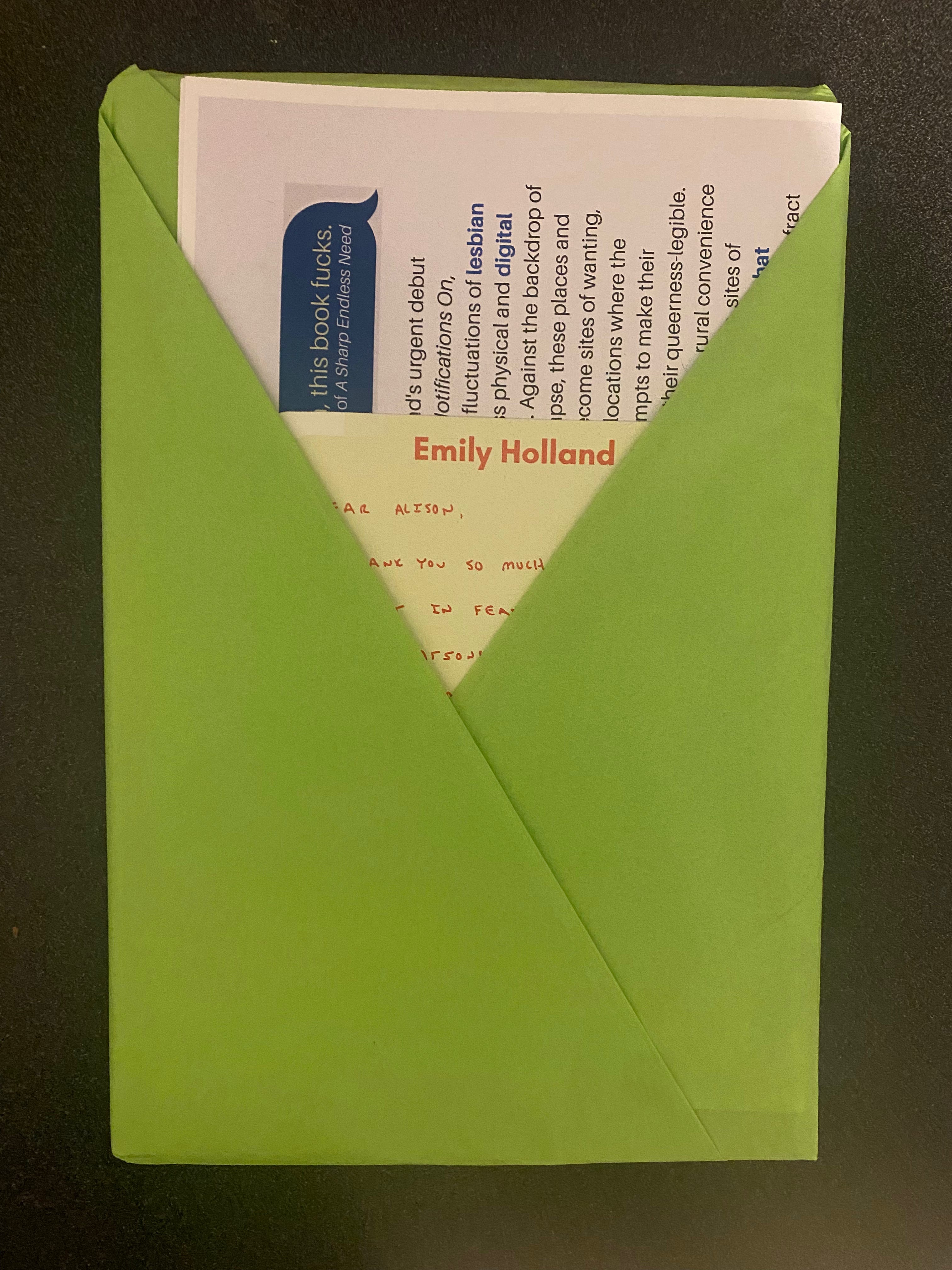
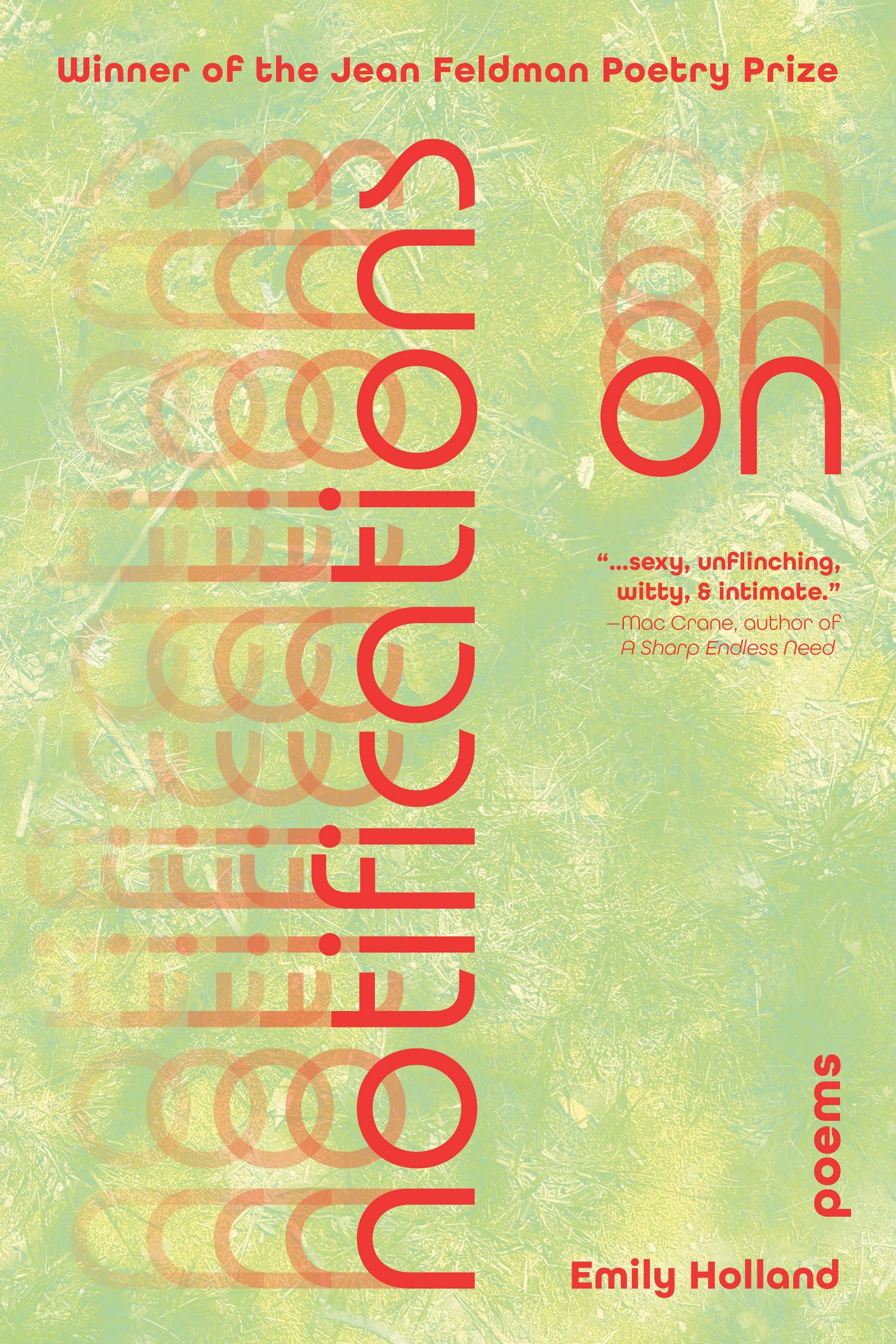
Emily Holland’s collection, Notifications On, wants to go with you on vacation. Wants to be on your motel bedside while a Bible sleeps in the nightstand drawer, wants you to crease her corners to mark pieces to read to a future, yet unknown lover, wants sand on her spine from a mid-October weekend beach day. Wants to be started on the phone to your long-distance girlfriend and finished when you’re together. You need a copy (and/or at least one for each member of the polycule).
It’s clear that Holland knows their sapphic ancestors. They begin with a note between Emily Dickinson and her lover, Susan, as an epigraph–Are you sure we are making the most of it? The “it” is everything: their lives, their love, their time. This moment. A sense of urgency underscores each following poem, a desire to seize the present and its demands. Holland responds with even more questions in their first poem, after witnessing the death of a bird: “Does the robin hit a window because she cannot see // or because she is trying to fight herself?” This is what social media can feel like: an urgent blindsiding, an internal conflict that spills into the external. Holland’s craft is clear, and their use of wide spaces between words and phrases suggest a breathless anticipation of the answer.
And yet the title, Notifications On, cements us in the digital. AOL Instant Messenger and chatroom experiences echo as snapshots, tableaus of locations. In an age where we carry the internet everywhere, Holland considers a memory-trigger to be a type of notification: a place as a reminder, memory, even all the girls they’ve kissed (which is graced with its own ghazal).
In “Necessary Intrusions,” Holland writes, “Every two hours, my / phone vibrates, begging for an interaction.” Is it possible that the phone, too, experiences desire? And we are its object? Amidst the Narcissus-like pull of our own video in Zoom meetings, the Anne Carson Twitter bot, (ancient) AOL chatrooms and their chorus of “A/S/L?,” the interruptions have become inextricable from a sense of connection.
But Holland knows she’s terrestrial, not digital. I love the way Joshua Tree materializes (a favorite place of mine), and the natural world finds a way in, even amidst Holland’s commentary on our digital lives. The robin from their first poem, the ducks and chickens who need feeding throughout, the last hidden cherries of the season, sapphic lineage nestled in violets and lavender, all echo a line from “Talking Stage”: “Language starts with the body.” This is true even as our identities are sampled for posts and well, notifications.
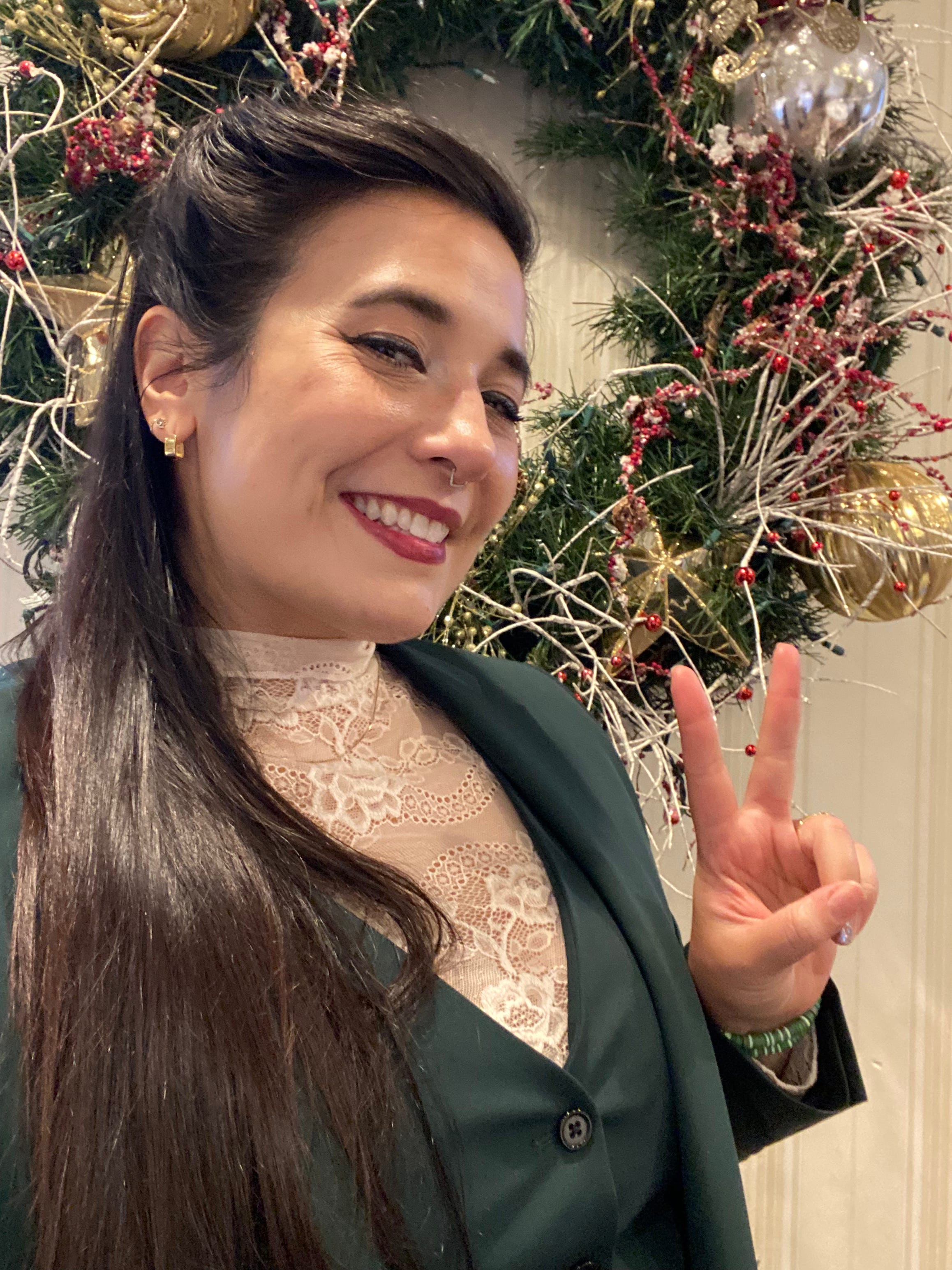
As a fellow genderqueer lesbian, I especially loved “Sometimes I Think of Gender When I’m Not Awake.” The freedom of a dream-self to choose a suit, even if “It fits too big, like on a boy” and the speaker knows “who” but not “what” they are resonates. “What” is ontological: a boy, a girl, a woman, a man. “Who” is based on action. “What” is looked at from the outside; “who” is internal. My own suiting experiences have previous been femme-coded–a dark green suit with wide-leg pants and a sheer lacy turtleneck beneath it all when I officiated a friend’s wedding–but I’ve just started playing with oversized linen blazers at work. The Platonic Ideal of the suit, for me, is Towa Bird’s looks for Gentleman. You can read about that here. (And stay tuned for a special interview and feature with Jully Nguyen on her expertise in menswear, as a Creative Director.)
What is common to both worlds, the digital and natural, are the many iterations of desire. In “One Day I Will Lose My Duolingo Streak,” Holland writes, “I want to be successful / at something that takes me outside of myself.” and “I hate that this is who we have become, letting an app / interrupt without thought.” A desire for external validation, to know who we are outside of a social media bubble, an uninterrupted moment with a lover, face-to-face.
The multiplicity of desire is also echoed in Holland’s meditations (and motif) of on the words “I love you,” as only a poet can know. In “Desire Lines,” they write, “Repetition / means nothing now. Who says it first. Too soon.”; in “Interruptions,” “That the first ‘I love you’ could never be the best?”; and in “Us, at Last,” “There are too many ways to live in I love you.” To “live in” this phrase means for it to become a positionality, a way of seeing the world. Beyond rose-colored-glasses, to see the world from the vantage point of love is not an idealization, but a tender appreciation and reverence. Holland’s love extends to their animals, the places they’ve lived, and every girl they’ve kissed.
Notifications On is confessional, intimate, and necessary. Buy one copy to keep pristine and the other to tear the pages, slip a poem into the hand of someone at the bar (if you’re in Philly, I recommend Val’s). As another great sapphic poet once wrote, “Tell me, what is it you plan to do / with your one, wild and precious life?” Holland offers one answer in the second sonnet of “Sonnets with an Abundance of Fruit”: “O, to take / one bite out of everything I’ve wanted / and fly away.”
—
just femme + dandy contributing writer and FUTCH ENOUGH columnist Alison Lubar is a queer, biracial Nikkei poet and educator who teaches literature to teenagers, writing to adults, and yoga to all ages. They’re the author of two full-length poetry books, The Other Tree, winner of Harbor Editions’ 2023 Laureate Prize, and METAMOURPHOSIS (fifth wheel press, 2024), as well as four chapbooks: Philosophers Know Nothing About Love (Thirty West, 2022), queer feast (Bottlecap Press, 2022), sweet euphemism (Mouthfeel Press, 2023), It Skips a Generation (Stanchion, 2023), and a microchap, American Kintsugi (Bull City Press, 2026). Alison is also a board member for Philadelphia’s Blue Stoop. Find out more at http://www.alisonlubar.com/.